Time delay estimation of traffic congestion propagation due to accidents based on statistical causality
TL;DR: This repository estimates the time delay of traffic congestion propagation caused by traffic accidents using transfer entropy and statistical causality. Lag-specific transfer entropy with sliding-window nonlinear normalization reveals the causal relationship between adjacent roads, and Markov bootstrap quantifies the uncertainty of the time delay estimator. Validated on simulated data and real GPS navigation trajectory data from South Korea.
Authors: YongKyung Oh, JiIn Kwak, Sungil Kim Venue: Electronic Research Archive (AIMS), vol. 31, no. 2, pp. 691-707, 2023 DOI: 10.3934/era.2023034 Project page: https://yongkyung-oh.github.io/TransferEntropy-Propagation/
Keywords: statistical causality, transfer entropy, time delay estimation, traffic trajectory data, traffic incident analysis
Earlier versions (preprints)
- Oh, Y., Kwak, J., Lee, J., & Kim, S. (2021). Time Delay Estimation of Traffic Congestion Based on Statistical Causality. [OpenReview]
- Oh, Y., Kwak, J., & Kim, S. (2021). Time delay estimation of traffic congestion propagation due to accidents based on statistical causality. [arXiv:2108.06717]
Overview
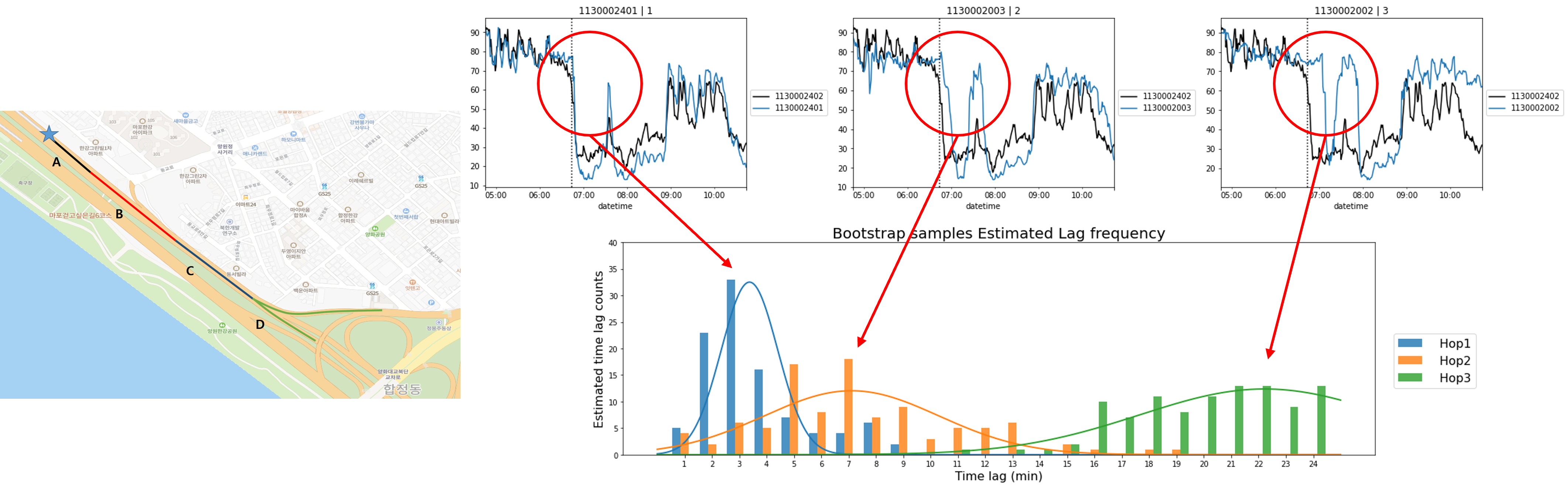
Abstract
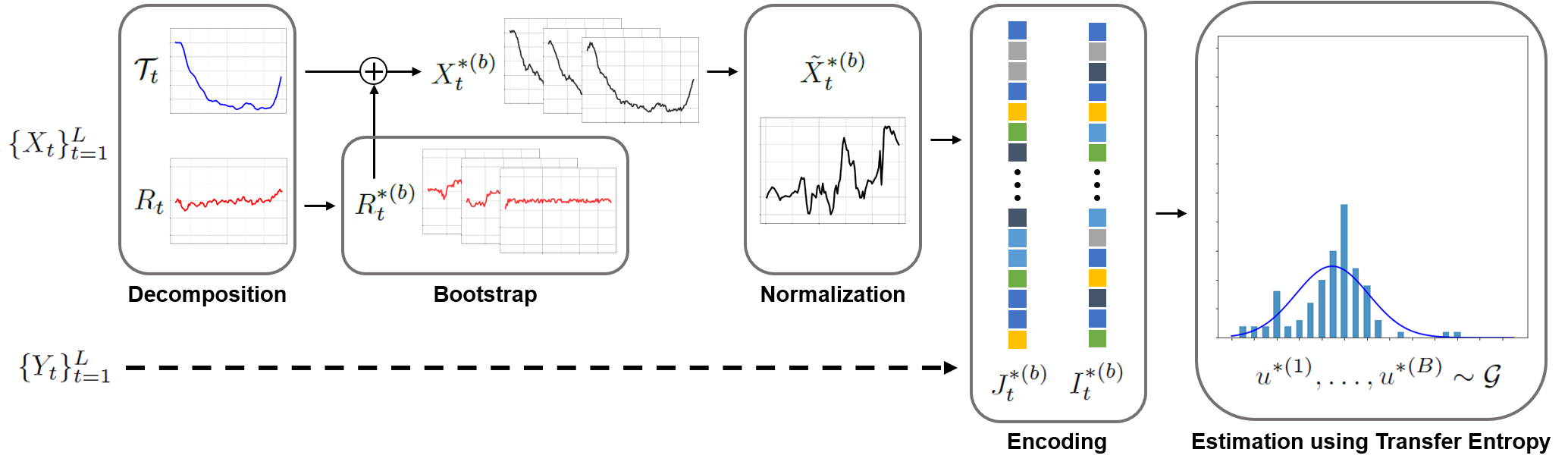
Obtaining accurate time delay estimates is important in traffic congestion analysis because they can be used to address fundamental questions regarding the origin and propagation of traffic congestion. However, estimating the exact time delay during congestion is a challenge owing to the complex propagation process between roads and high uncertainty regarding the future behavior of the process. To aid in accurate time delay estimation during congestion, we propose a novel time delay estimation method for the propagation of traffic congestion due to traffic accidents using lag-specific transfer entropy (TE). Nonlinear normalization with a sliding window is used to effectively reveal the causal relationship between the source and target time series in calculating the TE. Moreover, Markov bootstrap techniques were adopted to quantify the uncertainty in the time delay estimator. To the best of our knowledge, the proposed method is the first to estimate the time delay based on the causal relationship between adjacent roads. The proposed method was validated using simulated data as well as real user trajectory data obtained from a major GPS navigation system applied in South Korea.
Method
Prerequisite
Transfer entropy is computed with the R package ‘RTransferEntropy’, bound to Python via ‘rpy2’.
install.packages("RTransferEntropy") # in R
pip install rpy2 # in shell
Tutorial code
core contains key functions to estimate time lag with transfer entropy and bootstrap.
get_boot(x, y, lag=None, n_boot=100, plot=True, title=None, raw=None, save=None, curve=None):
'''
    x,y: source and target time series
    n_boot: the number of bootstrap
    plot: bool, return figure output
    title: figure title
    raw: comparison value (e.g. raw value without normalization)
    save: figure save path
    curve: if true, return fitted curve info
'''
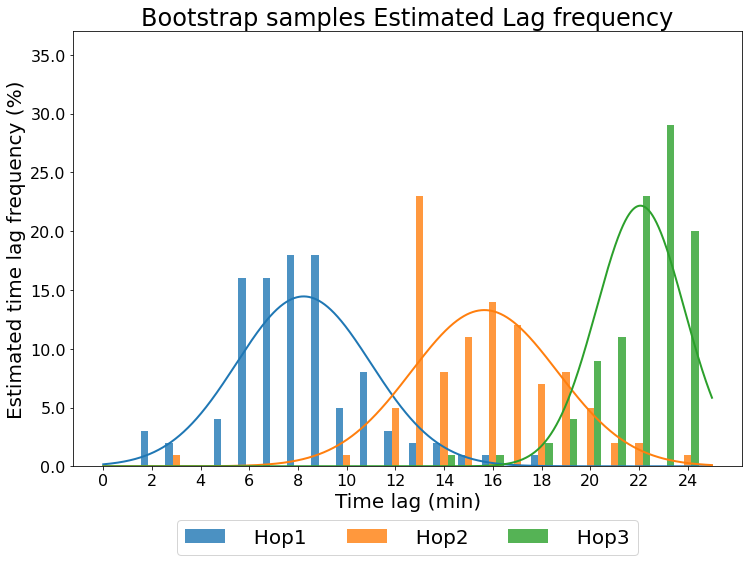
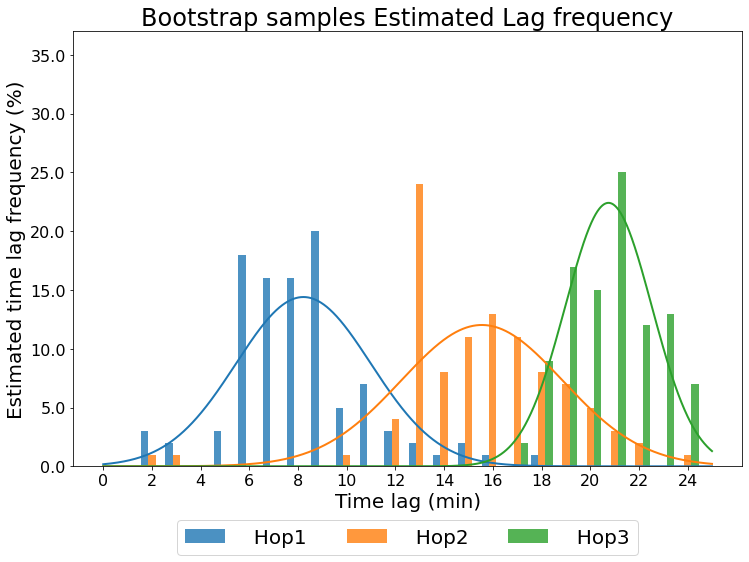
The function get_boot returns the bootstrap estimation of the time lag between two time series with an organized plot.
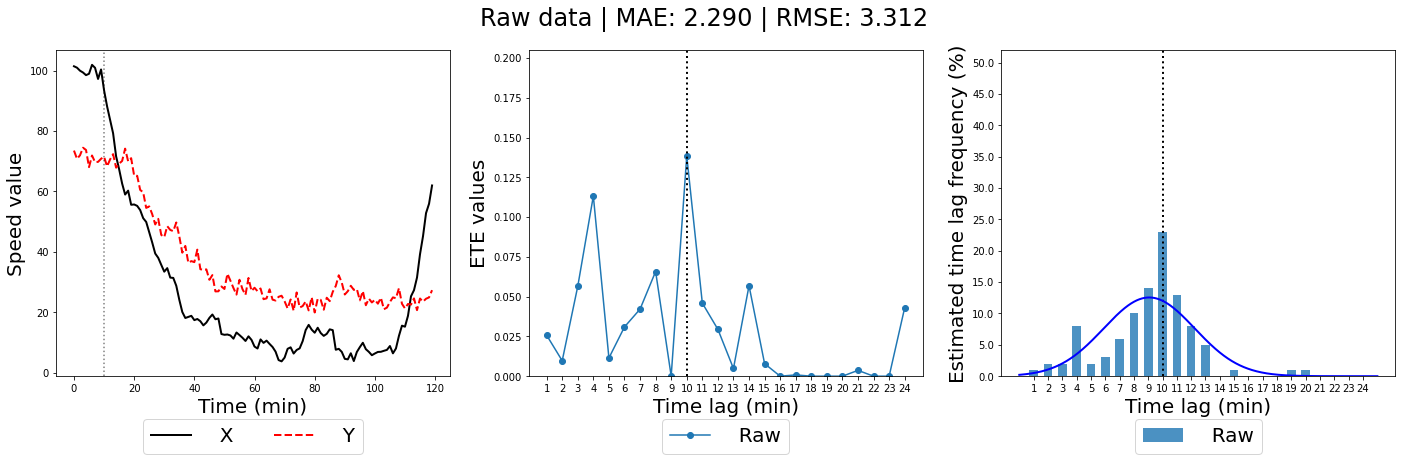
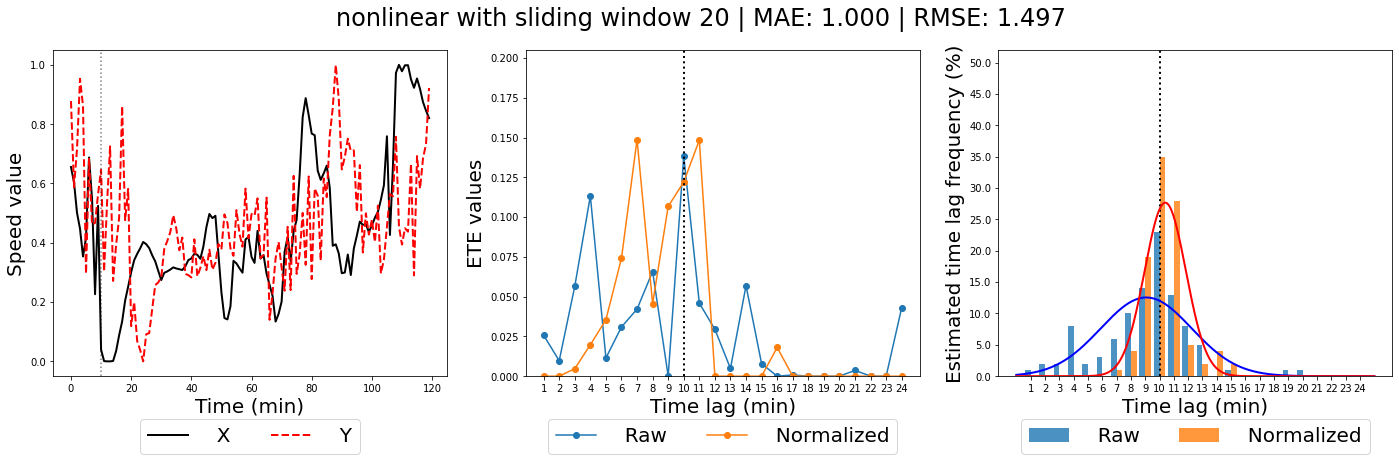
We can estimate the mean and standard deviation of the estimated time lag distribution using bootstrap. Simulation data and tutorial code are included in ‘Simulation’.
Real data example
The suggested algorithm can be applied to a multi-hop path in the traffic network as follows.
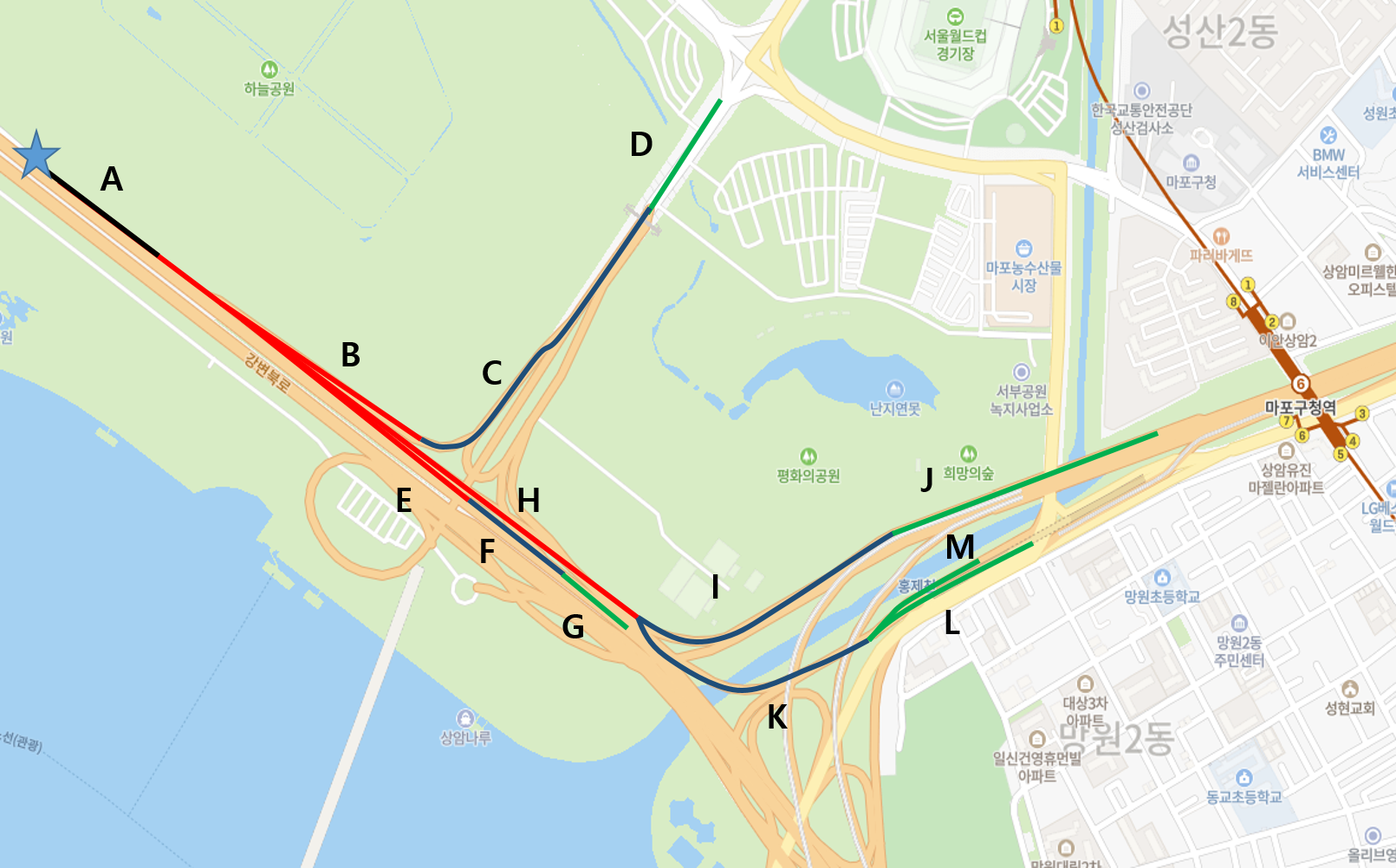
In this case there are 5 paths:
- path 1: [A, B, C, D]
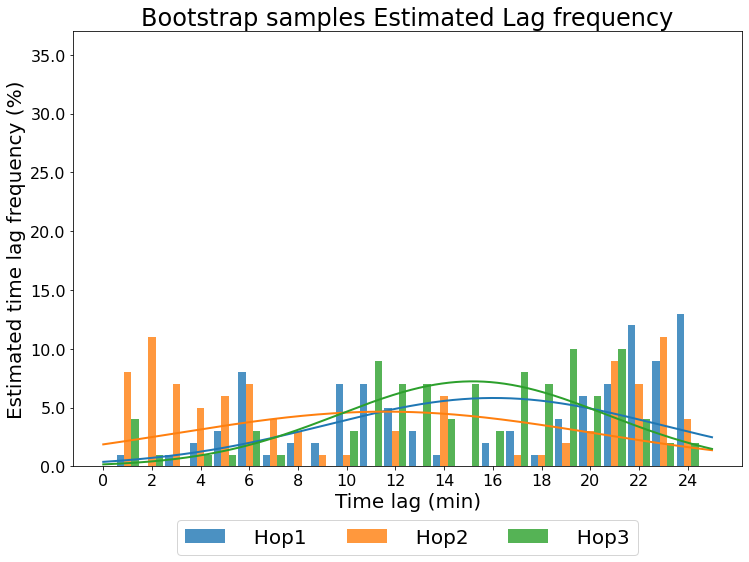
- path 2: [A, E, F, G]
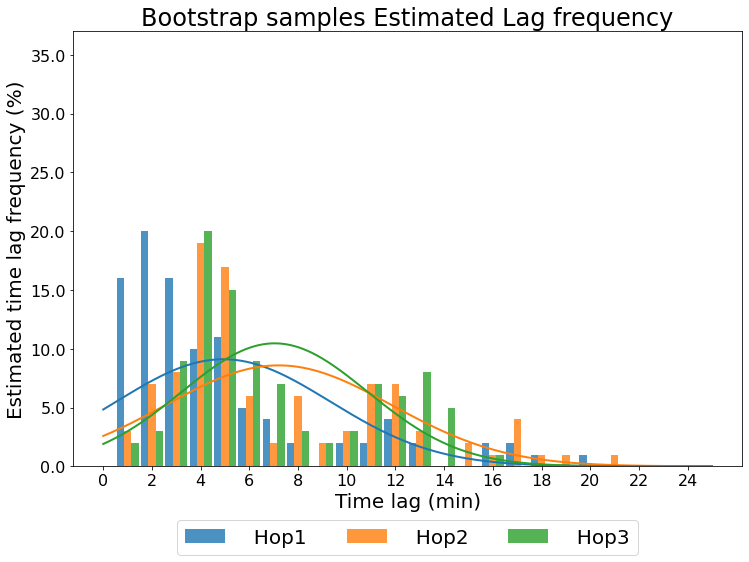
- path 3: [A, H, I, J]
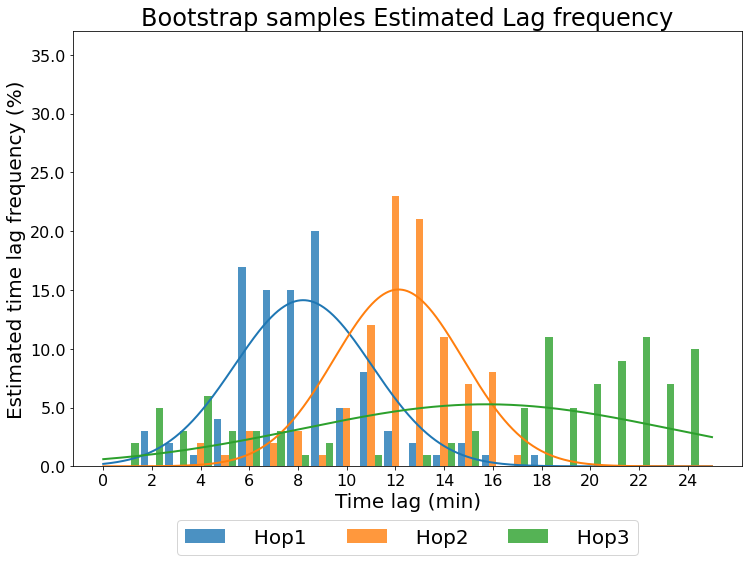
- path 4: [A, H, K, M]
- path 5: [A, H, K, L]
Citation
If you use this work, please cite the published paper:
@article{oh_time_2023,
  title   = {Time delay estimation of traffic congestion propagation due to accidents based on statistical causality},
  author  = {Oh, YongKyung and Kwak, JiIn and Kim, Sungil},
  journal = {Electronic Research Archive},
  volume  = {31},
  number  = {2},
  pages   = {691--707},
  year    = {2023},
  doi     = {10.3934/era.2023034}
}
@misc{oh_time_2021_arxiv,
  title     = {Time delay estimation of traffic congestion propagation due to accidents based on statistical causality},
  author    = {Oh, YongKyung and Kwak, JiIn and Kim, Sungil},
  year      = {2021},
  publisher = {arXiv},
  doi       = {10.48550/arXiv.2108.06717},
  url       = {https://arxiv.org/abs/2108.06717}
}
Reference
Behrendt, S., Dimpfl, T., Peter, F. J., & Zimmermann, D. J. (2019). RTransferEntropy—Quantifying information flow between different time series using effective transfer entropy. SoftwareX, 10, 100265.
License
Released under the MIT License.